
Book Review: Range
Amateur Isn’t An Insult

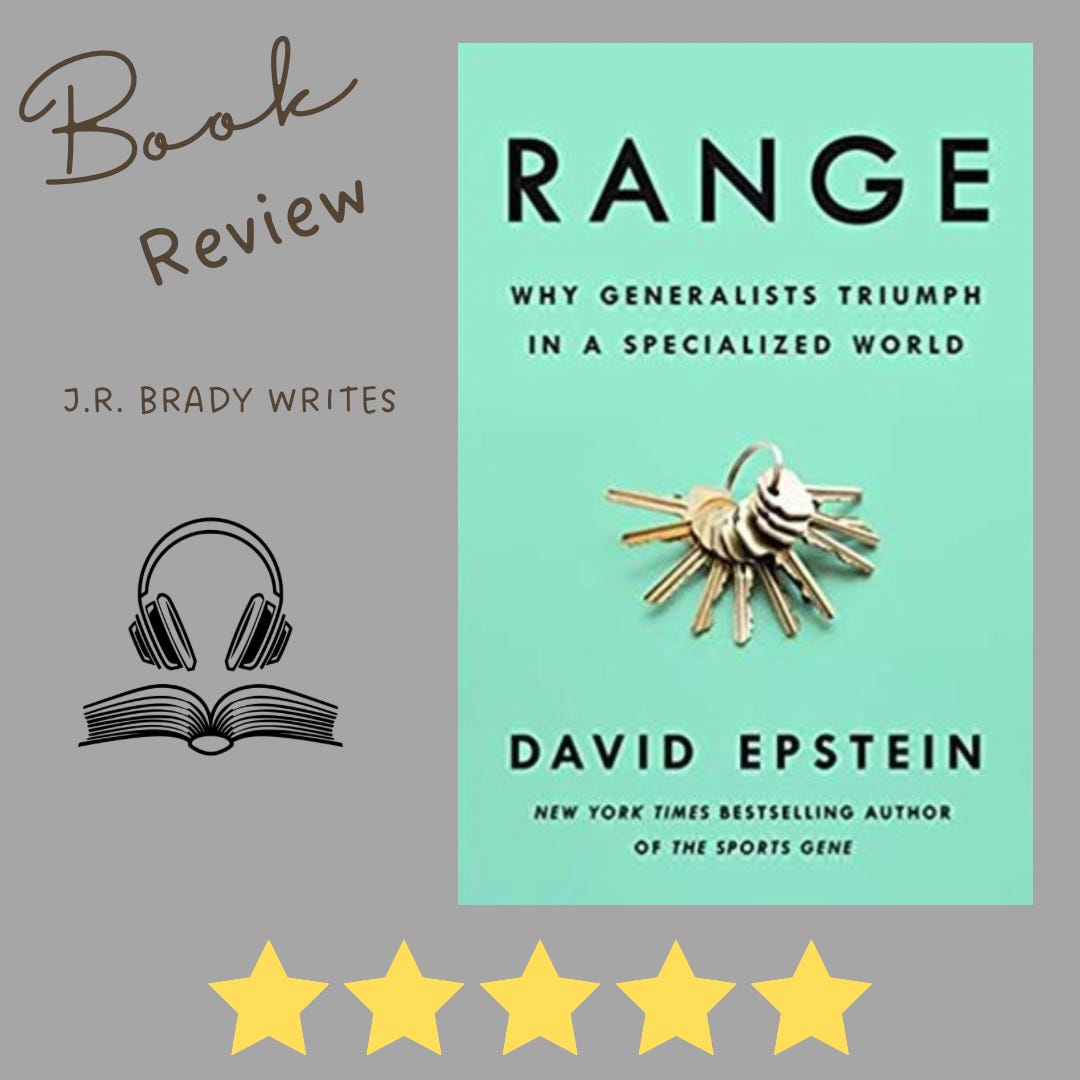
Range: Why Generalists Triumph in a Specialized World by David Epstein was one of the most thought provoking books I’ve read in a long time. Epstein is a science and sports writer and his thesis is backed by almost pages of contemporary and historical examples. It’s not a quick read, but he does break up sections and keeps your interest. (He gives examples from tons of other fields, not just sports.) I listened to this on audio and also read the paperback so I could highlight and make notes.
This topic piqued my interest as I have worked with high school students in the past and had a non-traditional education and college/career path myself. The author apparently released a young adult edition of this book and I want to find a copy. If it’s a good breakdown of the adult version I would recommend it to give as a gift or share with students!
“The question I set out to explore was how to capture and cultivate the power of breadth, diverse experience, and interdisciplinary exploration, within systems that increasingly demand hyper specialization, and would have you decide what you should be before first figuring out who you are.”
The book starts out by comparing the careers of two athletes, Tiger Woods (golf) and Roger Federer (tennis). Apparently, Wood has always been a cultural symbol of success = starting young and training with deliberate, repetitive practice. Federer on the other hand is an example of a kid who was competitive but wasn’t pushed by his parents. Instead was free to participate in multiple sports and didn’t begin his professional tennis career until later.
The author goes on to show that some skills like golf, chess, and firefighting benefit from narrow, repetitive experience because it relies on “domain specific memory.” Pro chess players seem to have crazy skills because they are able to memorize patterns by “chunking.” But this doesn’t translate to any other context in life. These are known as “kind learning environments.” Almost all other skills fall into the opposite domain of “wicked learning environments” where patterns aren’t predictable.
This book really hits home the point that our culture has taken an educational theory that only works in specific contexts and tried to force it into everything.
“Student’s get…narrow vocational training for jobs few of them will ever have.”
The rest of the book is full of examples of famous people in creative and scientific fields who excelled in “wicked” environments with non-linear career paths (Jack Cecchini, Van Gogh, Kepler, Darwin, the founder of Nintendo, and many more.) The chapter on how Army recruitment works and how they have had a problem for many years with poor “match-quality” was fascinating. Basically spending tons of money incentivizing recruits with free education that led them into careers other than the Army didn’t work out well.
I, like many, have been frustrated with our medical system that seems to only treat symptoms and not the body holistically. (There are other factors that contribute to this problem) but Epstein shows that hyper-specialization in research and medicine are big culprits.
“...highly credentialed experts can become so narrow-minded that they actually get worse with experience, even while becoming more confident- a dangerous combination.”
Epstein isn’t saying that all specialization is bad. He quotes a famous psychologist who used the illustration that people are “hedgehogs…deep but narrow” or “foxes…integrators… who know many little things” and you need both!
Another fascinating chapter was on the limits of data and “learning to drop your familiar tools” when it was necessary. One example is the tragic and preventable O-ring failure that caused the Challenger to explode in 1986.
“The Challenger decision was not a failure of quantitative analysis. NASA’s real mistake was to rely on quantitative analysis too much.”
I appreciate that he ends the book with some practical advice. He encourages parents to allow their kids to sample various experiences and not to push them into a narrow set of skills too soon. He also talks about resumes and how we often leave off jobs and experiences because we’ve been conditioned to think they should look linear and only relevant to the job we are seeking. (I’ve had this exact struggle!) He thinks resumes should be allowed to describe a “narrative journey” instead of using “bullet points.”
“I think it is culturally telling that we habitually hack off the end of the long version “a jack-of-all-trades is a master of none, but oftentimes better than a master of one.”
He encourages people to think differently when dealing with little kids and even older students. Why do we ask “what do you want to be when you grow up?” instead of “what things do I want to learn about/get better at this year?” This is something I want to implement with my children.
“The word amateur… did not originate as an insult, but comes from the Latin word for a person who adores a particular endeavor.”
If you have read to the end of this long review- thank you! I highly recommend this book-my ramblings don’t do it justice. I will probably have thoughts later on how this lines up well with Charlotte Mason’s educational philosophy for children, which is something I’ve been studying lately.

That's fascinating! And it absolutely aligns with frustrations I've heard from people who worked in small businesses (where they were jacks of all trades) and ended up in larger companies where everyone is a "master" of one (though master is hardly the right word in too many cases).
This is a great review. I have a couple of kids who are definitely interested in MANY trades but don't really care to master any of them. I'm going to look for the youth version of this book, for sure!